
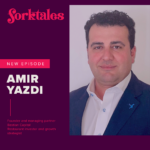

Amir Yazdi is the founder and managing partner of Bastian Capital, an investment firm focused on identifying, acquiring and growing restaurant and hospitality businesses. A former film producer, Amir transitioned into the restaurant industry more than two decades ago and has built a career scaling multi-unit operations, investing in emerging concepts and helping restaurant brands grow sustainably.
Bastian Capital invests in restaurant and hospitality businesses with an emphasis on operational excellence, scalability and long-term value creation. The firm owns and operates multiple restaurant concepts, including Subway, UNO Pizzeria & Grill and Coffee Bean & Tea Leaf locations, while also evaluating acquisition opportunities throughout the industry.
Before founding Bastian Capital, Amir attended the USC School of Cinematic Arts and worked as a film producer. He credits his experience as a bartender with teaching him valuable customer service and leadership skills that continue to influence his approach to business. Bastian Capital has grown from operating restaurants to acquiring and investing in brands across multiple states.
Amir believes every successful restaurant concept must be designed for replication. Strong systems, documented processes and operational consistency are what allow founders to scale beyond a handful of locations.
One of the biggest questions he asks when evaluating an investment opportunity is simple: Why is the owner selling? The answer often reveals whether the business still has meaningful growth ahead or has already reached its peak.
He cautions operators against assuming great single-unit managers will automatically succeed in multi-unit leadership roles. Scaling requires different skills, stronger infrastructure and the right people in the right positions.
Amir says restaurants ultimately spend money in two places: food and labor. Rising labor costs continue to reshape the economics of the industry, making operational efficiency and back-office infrastructure more important than ever.
He believes restaurants will continue to thrive because they provide something technology cannot replace. Beyond serving food, they create gathering places where families, friends and communities come together to celebrate, connect and build lasting memories.
While he believes robot servers have limited appeal outside certain concepts, Amir expects automation in restaurant kitchens and back-of-house operations to become increasingly important as operators manage labor shortages and rising wage pressures.
Looking ahead, Amir sees GLP-1 medications as one of the biggest long-term forces facing the restaurant industry. As access expands, he expects changing eating habits and shifting consumer behavior to influence menus, traffic patterns and restaurant economics across multiple segments.
QUOTES
“Everybody needs to work a service job at some point in their lives. You learn how to deal with people, you learn how to be humble, and learning how to roll with difficult customers is a vital life skill.” (Amir)
“The hardest step for us was going from four restaurants to five. That’s the point where you lose the ability to touch everyone all the time, and you realize you can’t do this by yourself.” (Amir)
“When I look at scalability, it’s about simplifying the operation to the point where, if I grabbed you off the street, I could teach you how to run this place in three days.” (Amir)
“We took all the guesswork out of the equation very early on, and that became a real catalyst for our ability to scale.” (Amir)
“Just because you’re an excellent single-unit manager doesn’t make you an excellent multi-unit manager.” (Amir)
“‘This is the way we’ve always done it’ is the worst possible answer to the question.” (Amir)
“There’s only really two things you spend your money on in this business: food and people.” (Amir)
“We’re just at the beginning of the GLP-1 story. When access expands, that’s going to be one of the biggest changes this industry has to navigate.” (Amir)
“People will always want to go out. There’s something about breaking bread together. Restaurants bring communities together, and sometimes you catch magic. You can’t replicate that anywhere else.” (Amir)
“There’s only so much price you can take. I always say, ‘Two is the new one.’ But if four becomes the new one, that’s a real problem for everybody.” (Amir)